4 Business Cases for Better Green Claims
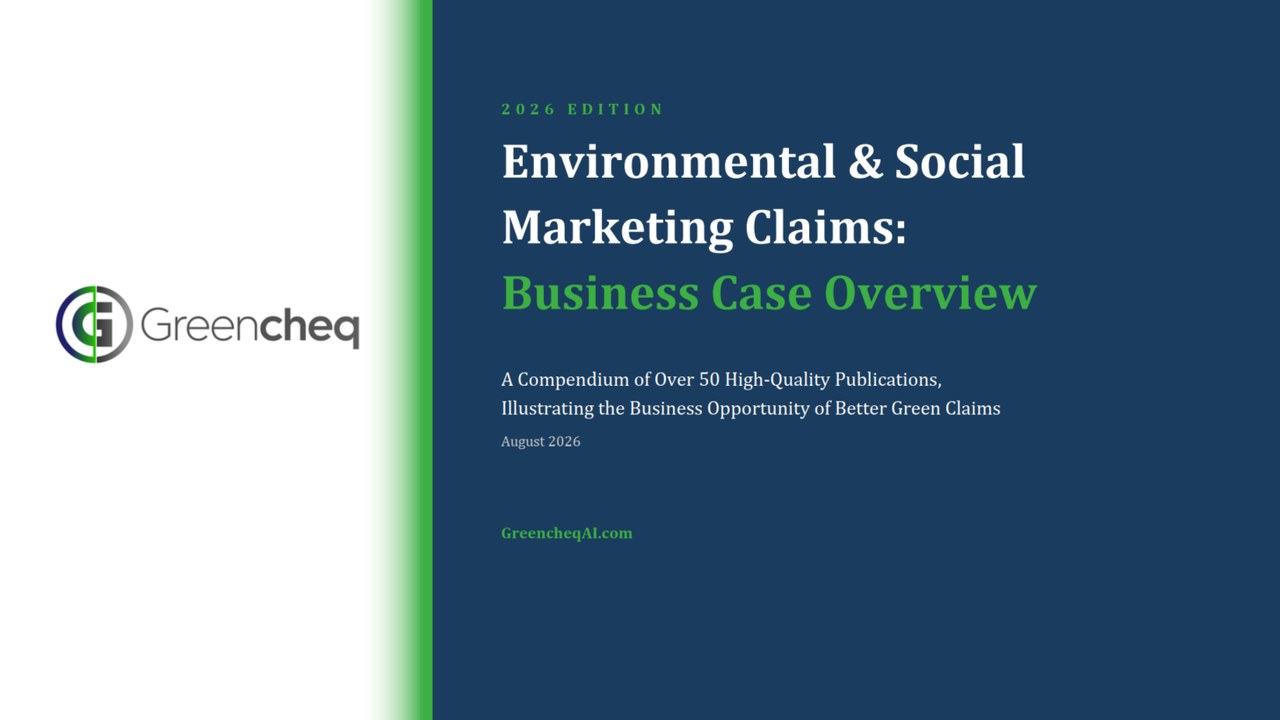
Introducing the 2026 Edition of the Environmental & Social Marketing Claims: Business Case Overview, a compendium of over 50 high-quality references illustrating the business opportunity of better green claims.
Brendan Edgerton, Founder & CEO · August 31, 2026 · 5 min read
Key takeaways
- Sustainability-marketed products hold 25.4% of US branded CPG sales and grow roughly five times faster than conventional products, delivering about half of all category growth.
- The specific, substantiated claims that earn the largest growth and price premiums are the same claims that survive the EU, UK and US enforcement regimes now in force.
- The 2026 Edition compiles almost 300 sourced data points from more than 50 publications, free to download and built for making the internal case.
Every team that puts a sustainability claim on a product eventually faces the same two questions. Is it worth making environmental and social claims at all? And if it is, how much does it matter that those claims are precise, substantiated and compliant?
For years the honest answer was "probably" and "a lot," backed by instinct and a handful of survey headlines. That is no longer good enough. Consumers say they care and will pay more, yet only one in five believe brands represent their sustainability efforts accurately. Regulators in the EU, UK and US have moved from guidance to penalties. Procurement teams treat sustainability as a tie-breaker. The question deserves a quantitative answer, and today we are publishing one.
What we built
The 2026 Edition of the Environmental & Social Marketing Claims: Business Case Overview brings together almost 300 data points from more than 50 reputable publications since 2020: retail sales data, household panel analysis, large-scale consumer and B2B surveys, regulator enforcement records and peer-reviewed research.
Every data point is presented with its source, its year and a link, so that anyone in your organization can trace it back and use it with confidence. We wrote it for the people who have to make the internal case: marketing, sustainability, legal and product leaders who need to show their colleagues why integrating sustainability into the product portfolio, and communicating it accurately, is worth the investment.
Four business cases, one conclusion
The evidence organizes into four sources of value, and each gets its own section with the supporting data.
Accelerated growth. Sustainability-marketed products now hold 25.4% of US branded consumer packaged goods dollar sales and have grown roughly five times faster than conventional products over the past five years. Two independent datasets show they deliver about half of all category growth. The demand is not only from consumers: half of B2B buyers already purchase more from sustainable suppliers, and more than 80% of procurement decision makers in the US and Europe say sustainability is at least sometimes the tie-breaker between competing suppliers.
Improved margins. Sustainability-marketed products carry an average shelf premium of 26.6% over their conventional counterparts. Consumers in broad surveys say they will pay 9 to 13% more, but when researchers test specific attributes in choice experiments, stated premiums land almost exactly where the shelf premium sits. What consumers will pay depends on how specific the claim is.
Customer loyalty. Brands whose sales are anchored in products with credible claims show repeat-purchase rates of 32 to 34%, against under 30% for brands that lean on them less. The reverse is just as real. More than half of consumers say they have encountered misleading sustainability information, and perceived greenwashing does not merely lower preference; it removes a brand from consideration.
Risk mitigation. From 27 September 2026, the EU's Empowering Consumers Directive bans generic claims such as "green" and "eco-friendly" without recognized certification, with fines starting at 4% of turnover. The UK CMA can now fine up to 10% of global turnover. The US FTC has used civil-penalty authority against major retailers, and greenwashing class actions in the US have passed 150. Inside companies, 58% of executives concede their organization has overstated its sustainability efforts, while only 36% have tools to measure them.
The insight that runs through all of it
The claims that earn the most commercial value are the same claims that survive regulatory scrutiny.
In the sales data, products carrying the least common, most specific claims grow at more than four times the rate of products carrying the most common, generic ones. Products with multiple substantive claims grow roughly twice as fast as products with one. And the claims that regulators are now banning, unqualified terms like "sustainable," unverified labels and offset-based neutrality claims, are precisely the ones that earn the smallest growth premium.
The growth strategy and the compliance strategy point in the same direction. Being specific, accurate and substantiated is not a constraint on effective marketing. It is what effective marketing looks like.
Where the value actually shows up
A few of the data points surprised even us.
- A label on its own barely moves behavior in a physical store. The effect is roughly four times larger online, and sustainable products hold a stronger share online than in-store in three-quarters of categories. E-commerce product pages are where substantiation is actually read.
- Credibility collapses on even a small gap between claim and performance. In a controlled experiment, a company that delivered 86% against a 90% claim lost nearly as much credibility as one that delivered 54%. Precision in the stated number matters more than the size of the underlying effort.
- Executives and consumers see trust very differently. 71% of business leaders believe the public trusts sustainability claims, while 20% of consumers believe brands represent their efforts accurately. Most internal cases for substantiation are being argued against an optimistic baseline.
Why we published this
Greencheq exists to help teams publish environmental and social claims that are effective, accurate and ready for the scrutiny they will face. We built the platform because 59% of companies have experienced marketing delays from claim compliance risk, and because the alternative, saying less or saying nothing, leaves growth on the table.
This document is the evidence behind that belief. It is free to download, it is fully sourced, and it is designed to be passed along to whoever in your company is making, approving or defending environmental and social claims.
Download the 2026 Edition (PDF) →
Follow Greencheq on LinkedIn for updates as new data, enforcement actions and regulatory deadlines emerge. And if you are ready to make your next claim with confidence: did you Greencheq it?